The specificity principle of training states that a tissue or system will adapt to the specific demands placed upon it. Coaches and practitioners understand that this translates, at least in part to “train the way you play”. But is there a different way to look at “train the way you play”? This article explores the specificity principle and asks the question – when it comes to maximizing training adaptations, should we simulate or stimulate?
How Do the Best Coaches Simulate Competition Demands?
Given that the “greatest improvements in performance occur when the physical demands and movement patterns replicate the demands of the sport” (6), competition simulations are commonly used by sport coaches and performance staff to prepare their athletes for the specific demands of competition. There are several benefits of competition simulations, including:
- Exposing athletes to intense physical demands and game/race conditions that typically cannot be concurrently achieved with any single training modality in isolation;
- Acclimating athletes to scenarios they are likely to face in competition;
- Improving transfer of physical and skill qualities to the competitive environment.
In individual sports such as swimming and track running, race simulations (sometimes over shorter distances than those experienced in competition) are regularly used. In team sports, game-based training (e.g. in the form of small- or large-sided games) is commonly used to simulate competition demands and create game-like pressure (5). Equally, given the importance of repeated-sprint and repeated-effort ability to match outcome in team sports such as field hockey, soccer, and rugby, several researchers have developed tests and training drills to assess and develop these qualities (2,4).
Competition Simulations Cannot Effectively Stimulate Specific Adaptations
If competition simulations were the best way to elicit specific training adaptations, then this would be the only activities that coaches would use! The only training track athletes would do is races and team sport athletes would just play games! Although I am an advocate of competition simulations, there are some limitations with the approach that should be considered. Firstly, several team sport studies have shown that competition simulations (in the form of small-sided games) did not adequately meet the extremely demanding repeated-sprint demands of competition (1,3). Perhaps this is a reflection of the quality of the small-sided games that were developed – but regardless, it demonstrates that players were receiving an inadequate training stimulus to prepare them for the most demanding passages of match-play. Secondly, because of the variable nature of small-sided games, many physical qualities will be trained concurrently, but none will be specifically targeted. As an example, given that strength is an underpinning quality for repeated-sprint and effort ability, it would be severely undertrained if coaches relied solely on game-based training to develop this physical quality.
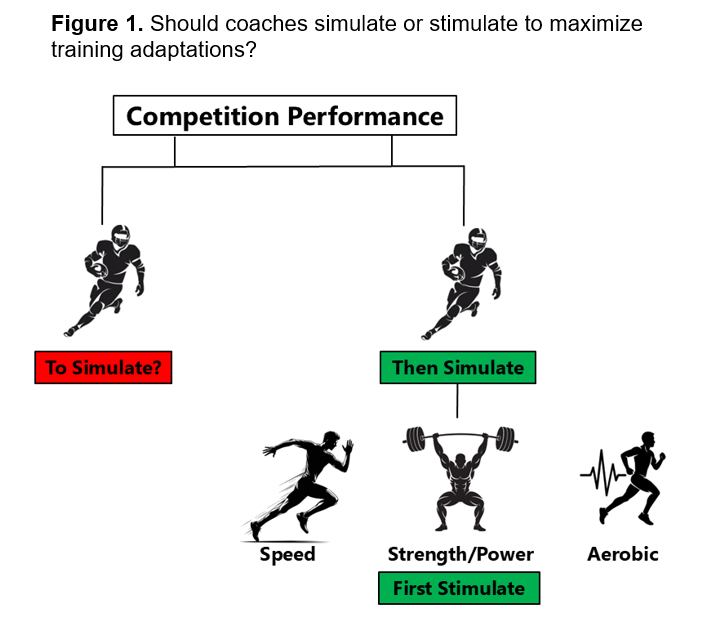
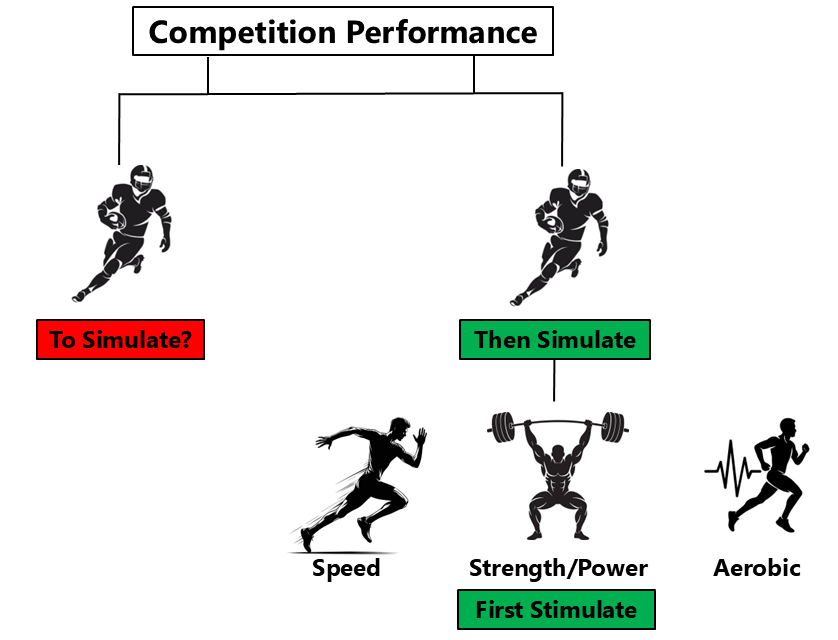
To Simulate or Stimulate? It’s Not an “Either/Or” Question!
The best coaches and performance staff use a combination of appropriately designed training to elicit specific training adaptations and employ competition simulations to improve transfer. For performance and rehabilitation goals, employing either in isolation will result in an underprepared athlete. A reliance on isolated strength and conditioning risks athletes developing skills and physical qualities in a decontextualised environment that do not transfer to competition, while the use of competition simulations alone, without first stimulating specific adaptations is akin to skipping the entire early- and intermediate stages of the rehabilitation process and then returning the athlete straight back to competition! Ideally, coaches should stimulate to maximize training adaptations and then simulate to promote transfer to the competitive environment.
Prefer to study at your own pace and keep the resource forever? Check out our Online courses here!
References
1. Gabbett, T.J. (2010). GPS analysis of elite women’s field hockey training and competition. Journal of Strength and Conditioning Research, 24:1321-1324.
2. Gabbett, T.J. (2010). The development of a test of repeated-sprint ability for elite women’s soccer players. Journal of Strength and Conditioning Research, 24:1191-1194.
3. Gabbett, T. and Mulvey, M. (2008). Time-motion analysis of small-sided training games and competition in elite Women’s football players. Journal of Strength and Conditioning Research, 22:543-552.
4. Gabbett, T.J. and Wheeler, A.J. (2015). Predictors of repeated high-intensity effort ability in rugby league players. International Journal of Sports Physiology and Performance, 10:718-724.
5. Gabbett, T., Jenkins, D., and Abernethy, B. (2009). Game-based training for improving skill and physical fitness in team sport athletes. International Journal of Sports Science and Coaching, 4:273-283.
6. Magill, RA. (2001). Motor learning: concepts and applications, 6th Edition. McGraw-Hill, Boston.